
Adding shape and volume to the buttocks with your own fat or implants, decided after a review of your anatomy and safety, not from a photo online.
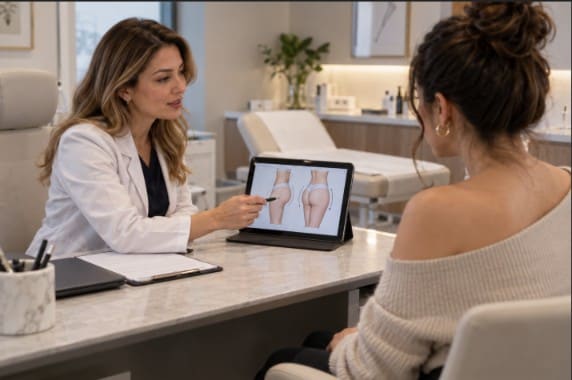
Buttock augmentation enlarges or reshapes the buttocks with either your own fat (fat transfer, widely known as a Brazilian butt lift) or silicone implants. Fat transfer means liposuction elsewhere on the body, then injecting that fat into the buttocks.
Moving fat into the buttocks has one particular, serious danger: fat getting into the large veins that lie under the muscle. Professional safety guidance says fat should go only into the layer above the muscle, and an experienced surgeon builds the whole procedure around that rule.
Read this as a general outline. Only the surgeon who would operate can say whether the operation suits you, once they have examined you in person, gone through your medical history and seen any tests they ask for.
You send photos and your medical history, and the surgeon tells you whether the operation looks suitable and what it could realistically do for you.
The surgeon examines you, finalises the plan, takes you through the risks and arranges the pre-operative tests; only then do you sign the consent form.
Under general anaesthetic, fat is collected by liposuction and placed above the muscle, or implants are inserted through a small cut.
Before you leave, the surgeon checks how you are healing. You go home with written aftercare instructions and remote follow-up.
Avoid sitting or lying directly on your buttocks, using a special cushion if you are told to. Compression garments go over the liposuction areas.
You start sitting again bit by bit. Swelling and bruising fade, and light activity resumes.
The body absorbs part of the transferred fat. By now, what remains has usually settled.
Everyone heals at their own pace, and the instructions from your clinic always come first.
It is riskier than many cosmetic operations. Sticking to current safety guidance, including placing fat only above the muscle, lowers that risk but cannot remove it.
That depends on how much fat you have to spare, your skin and your build. The surgeon advises on an amount that is safe and realistic.
That varies with the operation. Many trips are planned for one to two weeks, so the surgeon can see you and take out stitches or drains before you go. Flying too soon after surgery makes blood clots more likely, so your surgeon tells you when it is safe to fly.
It depends on the operation the surgeon advises after examining you, the nights in hospital and anything done at the same time. You get an itemised quote in writing before you book, and you are free to say no.
Buttock Augmentation is priced individually after a specialist reviews your case. You receive a written, itemised quote before anything is booked.
From your first message to care after you are home, in eight clear stages for patients travelling in.
Step 1 / 8
Share what you would like to treat, your health background and when you hope to travel, using a short form or a message.
Intimate surgery, talked through in private, where comfort and function count as much as appearance.
View treatment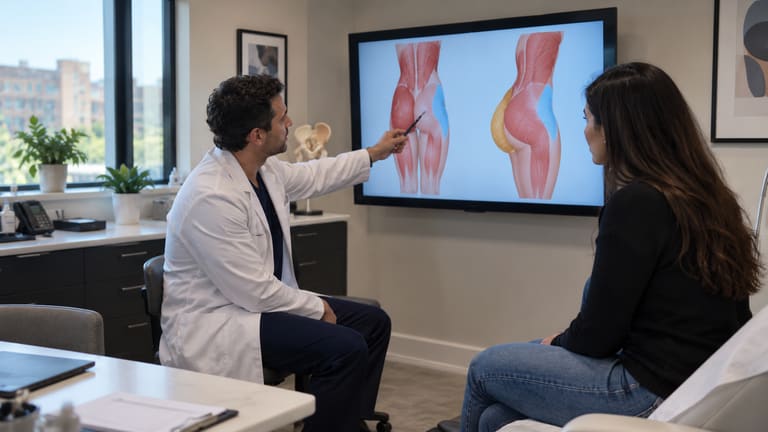
Removing fat from chosen areas once the surgeon has checked your skin and a safe amount; it shapes the body, it is not a way to lose weight.
View treatment
A plan for after pregnancy that can combine breast and tummy surgery, in one session only if that stays safe for you.
View treatmentSend your details and your coordinator will explain what comes next. You are free to stop at any point.
This page is general information, not medical advice; a treating clinician confirms your plan after assessment. ELAVIA Global coordinates care; clinical evaluation and treatment are delivered by independent, licensed partner facilities and their specialists.
ELAVIA Global coordinates international patient care. Clinical services are delivered by independently operated facilities.