
Removal of a large part of the stomach to leave a narrow tube, planned after a medical evaluation and never sold as a ready-made online deal.

A sleeve gastrectomy removes roughly three quarters of the stomach for good, by keyhole surgery, leaving a slim tube or “sleeve”. Smaller portions fill you up, and a hunger hormone made in the part that was removed drops.
There is no undoing it. The intestine is not rerouted, so absorption of nutrients is affected less than after a bypass, but lifelong supplements and follow-up are still required. It can bring on or worsen acid reflux, which is checked before surgery.
See this as a general outline. The surgeon and team decide whether a procedure suits you once they have gone through your medical history, your tests and an in-person assessment, never from weight or BMI alone.
You send your height, weight, health conditions, medicines, past operations and recent blood results. The team decides whether an assessment makes sense and what else is needed before you travel.
You see the surgeon and the anaesthetist and have blood tests and other checks, often an ultrasound or endoscopy. A dietitian explains the eating plan, and the operation goes ahead only if it still looks right for you.
Under general anaesthetic, through several small cuts, most of the stomach is divided with a stapler and taken out.
You leave with written instructions on diet and medicines. Support from the clinic’s dietitian and regular blood tests carry on remotely and with your own doctor at home.
You stay in hospital, generally two to four nights. You are walking early to lower the risk of clots, begin with small sips of clear fluid and get pain relief and blood-thinning injections.
You live on liquids taken little and often. Most people are back at a desk after about two weeks, still avoiding heavy lifting.
You move step by step to puréed and then soft food, eating slowly and stopping as soon as you feel full. Daily vitamin and mineral supplements start.
Most of the weight comes off in the first twelve to eighteen months. Regular check-ups and blood tests pick up any shortages early.
Everyone heals at their own pace, and the instructions from your clinic always come first.
Because whether it suits you depends on your medical history, any reflux, your test results and how ready you are for life afterwards. A responsible team settles the plan only after assessing you, and may advise another procedure or none at all.
Yes. This is sometimes done for severe reflux or too little weight loss, but it is another operation with risks of its own.
In most cases, yes. After weight-loss surgery, people generally need daily supplements and regular blood tests for life to avoid shortages of things like iron, vitamin B12, calcium and vitamin D.
For weight-loss surgery, most people stay about seven to ten nights: the assessment, the operation, a few nights in hospital and a check before flying. Your surgeon tells you when it is safe to fly, as flying too soon after surgery raises the risk of blood clots.
It depends on the procedure advised after your assessment, the nights in hospital and any extra tests. You get an itemised quote in writing before you book, and you are free to say no.
Sleeve Gastrectomy is priced individually after a specialist reviews your case. You receive a written, itemised quote before anything is booked.
From your first message to care after you are home, in eight clear stages for patients travelling in.
Step 1 / 8
Share what you would like to treat, your health background and when you hope to travel, using a short form or a message.

A balloon placed in the stomach through an endoscope, discussed when surgery is not the first thing your doctor would advise.
View treatment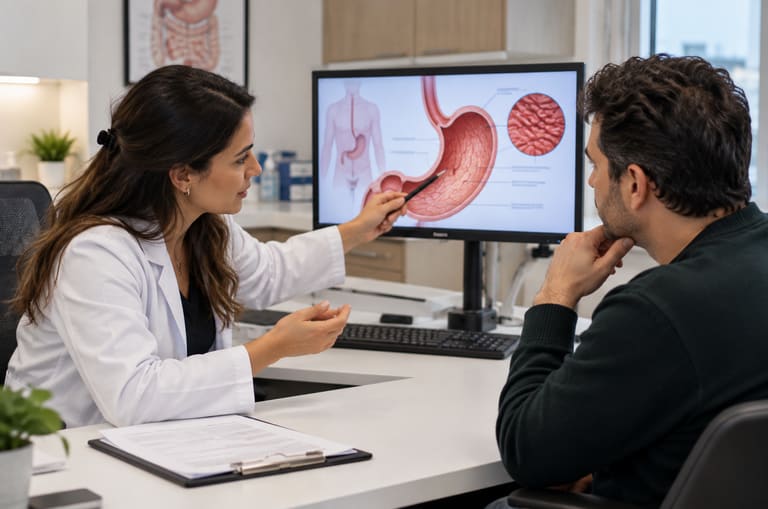
Botulinum toxin injected into the stomach wall through an endoscope; it does not replace weight-loss surgery when surgery is needed.
View treatment
A bypass with one connection that shrinks the stomach and diverts food; it is not a milder sleeve, and it is never chosen just to reach a target weight.
View treatmentSend your details and your coordinator will explain what comes next. You are free to stop at any point.
This page is general information, not medical advice; a treating clinician confirms your plan after assessment. ELAVIA Global coordinates care; clinical evaluation and treatment are delivered by independent, licensed partner facilities and their specialists.
ELAVIA Global coordinates international patient care. Clinical services are delivered by independently operated facilities.